Evidence law study guide: how admissibility fits together
November 9, 2026 · by Frank Alfano, LL.B., LL.M.
Evidence problem questions hide a separate argument in every fact. One five-step sequence for relevance, hearsay, bad character and confessions, for University of London LLB students.
An Evidence problem question looks friendly for about four seconds. There is a burglary, a neighbour who saw something, a text message, a police interview that went on rather too long, and a defendant with a record. Then the question asks you to advise on the evidence, and you realise every single fact is a separate argument waiting to happen. If your first instinct is to write out every exclusionary rule you have ever met and hope the examiner finds the relevant one, we understand. Please do not.
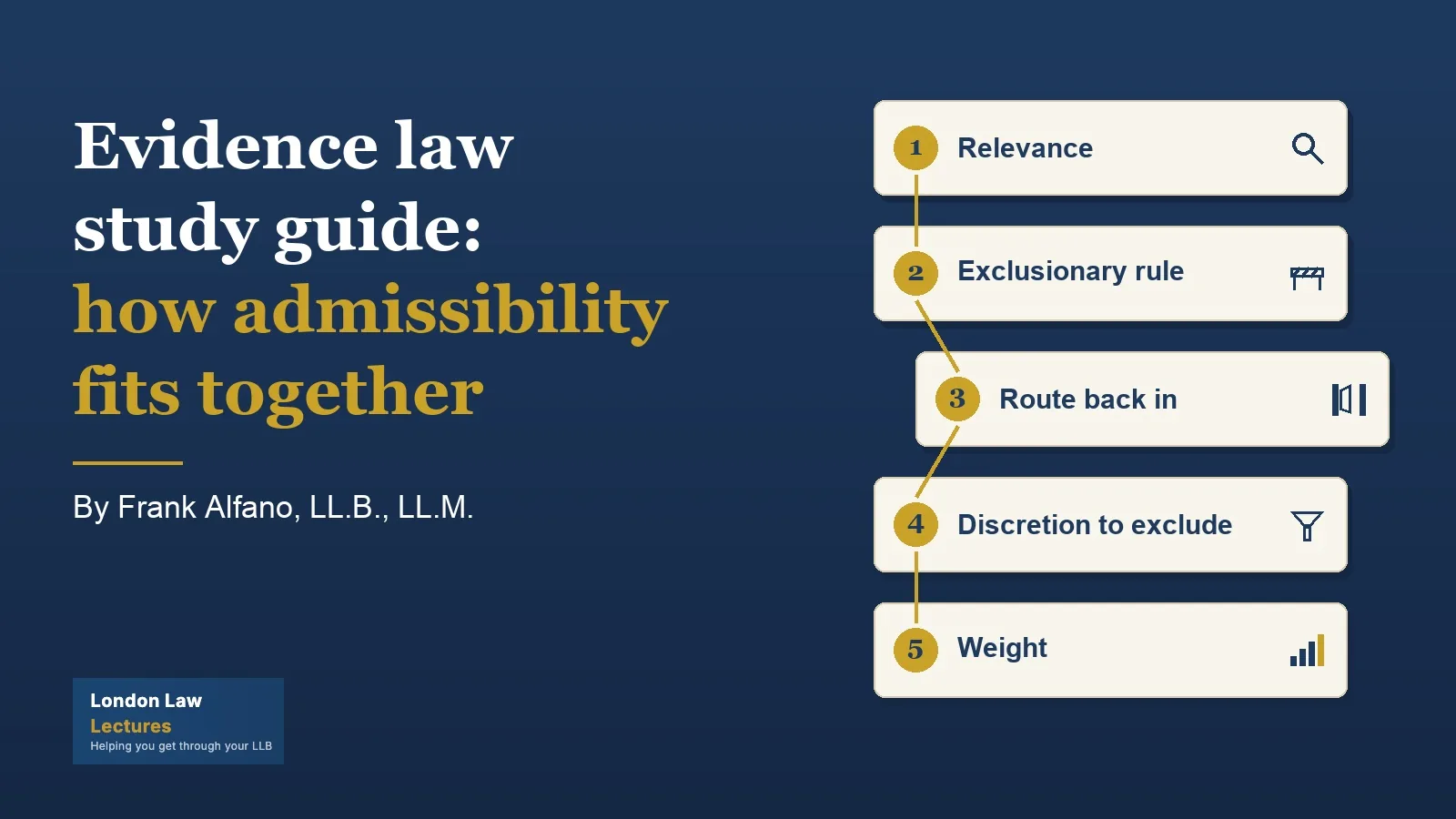
Evidence law has a shape, and this evidence law study guide is about seeing it. For University of London LLB students taking Evidence as an optional module, the subject gets easier once you stop treating it as a list of rules and start running one sequence on every item of evidence. Is it relevant? Does an exclusionary rule bite? Is there a statutory route back in? Should the court still keep it out? And if it goes in, how much weight does it carry? Each rule then becomes a station on that route.
What the Evidence module asks you to do
The University of London's module page for Evidence (LA3007) describes it as an optional module on the Standard Entry and Graduate Entry LLB. Its topics start with relevance, admissibility and weight, then cover the burden and standard of proof, confessions and improperly obtained evidence, the right to silence, character evidence, hearsay and expert evidence, among others. The learning outcomes ask you to construct arguments for and against the relevance and admissibility of a particular piece of evidence. Read that twice: the module wants argument about specific evidence, from both sides, not recital.
Our Evidence subject page sets out what we teach, from burden and standard of proof to competence and compellability of witnesses. As a list, it is long. As questions you put to each item of evidence, it is surprisingly compact.
A note on scope: what follows is the law of England and Wales, mostly in criminal proceedings, where the exclusionary rules do most of their work.
One sequence for every item of evidence
Learn this sequence before anything else in the subject, because everything else hangs off it.
- Relevance. Does the item tend to prove or disprove a fact in issue? Irrelevant evidence goes nowhere, however dramatic it is. Relevant evidence is only the starting point.
- The exclusionary rule. Does a rule of exclusion apply to this type of evidence? The big ones in the module are hearsay, bad character, confessions and improperly obtained evidence.
- The route back in. If a rule bites, is there a gateway that makes the evidence admissible anyway? For hearsay and bad character, the gateways are statutory and specific.
- Discretion to exclude. Even if the evidence passes a gateway, can the court refuse to admit it because it would make the proceedings unfair?
- Weight. If it goes in, how much should the tribunal of fact rely on it, and does the judge need to give a warning or direction about it?
The sequence stops two classic mistakes. One is stopping at step two ("this is hearsay, so it is inadmissible") when the marks are in step three. The other is treating relevance as if it settled admissibility. Relevance gets evidence to the door; the exclusionary rules decide whether it comes in.
You do not have to invent this kind of structure from nothing. In Riat [2012] EWCA Crim 1509, at paragraph 7, the Court of Appeal said the statutory hearsay framework can usefully be considered in successive steps, starting with whether there is a specific statutory gateway and ending with whether the case should be stopped after the evidence is admitted. Our five stations are a teaching device for the whole module; Riat is the court's own version for hearsay.
Hearsay: the rule and the gateways
What counts as hearsay
In criminal proceedings, the starting point is section 114 of the Criminal Justice Act 2003. It provides that a statement not made in oral evidence in the proceedings is admissible as evidence of any matter stated if, but only if, one of four conditions is met. Section 115 then defines a statement as any representation of fact or opinion made by a person by whatever means, including a sketch or photofit, and limits the matters stated to which the hearsay rules apply to those where the maker's purpose, or one of them, appears to have been to cause another person to believe the matter, or to cause someone to act or a machine to operate on the basis that it is as stated.
That purpose test matters. Before you call something hearsay, ask what it is being used to prove. If it is relied on as evidence that what it says is true, and the maker intended someone to believe it, you are in hearsay territory. If it is used for another reason, such as showing that the words were said at all, the analysis may differ. Slow down here.
The four routes in section 114
Section 114(1) gives four ways in: another statutory provision makes the statement admissible; a rule of law preserved by section 118 does; all parties agree; or the court is satisfied that admission is in the interests of justice. For that last route, section 114(2) lists nine factors, including the statement's probative value, its importance to the case, the maker's apparent reliability, whether oral evidence can be given, and how hard the statement would be to challenge.
The interests of justice route sounds flexible, so students reach for it first. Check the specific gateways before you fall back on it, which is also the order in Riat.
The specific gateways
Section 116 covers cases where a witness is unavailable. The statement is admissible if oral evidence from its maker would have been admissible, the maker is identified to the court's satisfaction, and one of five conditions applies: the maker is dead; unfit to be a witness because of bodily or mental condition; outside the United Kingdom where it is not reasonably practicable to secure attendance; cannot be found despite reasonably practicable steps; or does not give evidence through fear, in which case the court's leave is needed. Section 116(5) adds a sting in the tail: a condition is treated as not satisfied if the party relying on the statement, or someone acting for them, caused it in order to stop the witness giving evidence.
Section 117 covers business and other documents created or received in the course of a trade, business, profession or office. Section 118 preserves certain common law categories, including res gestae statements made by someone so emotionally overpowered by an event that concoction or distortion can be disregarded. Section 121 adds a hurdle for multiple hearsay.
The safety valves after admission
Passing a gateway is not the end. Section 126 lets the court refuse a hearsay statement where the case for excluding it substantially outweighs the case for admitting it, and preserves section 78 of PACE. Section 125 requires the judge in a jury trial to direct an acquittal, or discharge the jury, if a case based on hearsay is so unconvincing that a conviction would be unsafe.
There is also a human rights dimension the module expects you to know. In R v Horncastle [2009] UKSC 14, Lord Phillips, at paragraph 108, concluded that the court should not apply a "sole or decisive" test in place of the provisions of the 2003 Act, read in their natural meaning, and said those provisions strike the right balance between a fair trial and the interests of victims and society. If a question asks whether a conviction can rest heavily on hearsay, that is the authority to discuss, together with the statutory safeguards.
And in civil proceedings
Civil proceedings take a very different approach. Section 1 of the Civil Evidence Act 1995 provides that in civil proceedings evidence shall not be excluded on the ground that it is hearsay. Hearsay there is mainly a question of weight. If an exam question is set in a civil context, saying "inadmissible hearsay" is a quick way to lose marks.
A worked hypothetical: the neighbour who moved abroad
This is a hypothetical with invented names, written to show the sequence at work. It is not drawn from any real case.
Priya Nandakumar is charged with burglary of a flat. Her neighbour, Tomasz Wilk, gave the police a signed written statement saying he saw her climb out of the flat's window at about midnight. Before trial, Tomasz moved to Canada for work. The prosecution wants to read his statement to the jury.
Relevance. The statement places Priya at the scene at the relevant time. It plainly tends to prove a fact in issue. Through the door.
Exclusionary rule. The statement was not made in oral evidence in the proceedings, it is relied on as evidence that what Tomasz saw is true, and Tomasz made it to the police so that they would believe it. It is hearsay under sections 114 and 115.
Route back in. Start with section 116. Tomasz's oral evidence would have been admissible and he is identified. He is outside the United Kingdom, so the real question is whether it is reasonably practicable to secure his attendance. Say which facts you would want: what efforts were made and whether he could give evidence another way. Then check section 116(5): nothing suggests the prosecution caused his move, but say you checked.
Discretion to exclude. Even if section 116 is satisfied, the defence can argue under section 126 of the 2003 Act and section 78 of PACE that admission would be unfair, for example if the identification was made in poor light and the defence cannot test it by cross-examination. Weigh what material exists to test the statement.
Weight. If admitted, the jury will need help understanding the limits of evidence that has not been tested in cross-examination, and if the case rests heavily on it, section 125 and Horncastle become relevant.
Five short paragraphs, each doing one job and each tied to a provision. That is a shape an examiner can follow.
Bad character: gateways, not a blanket ban
Many students arrive believing a defendant's record can never be mentioned. The statute works the other way round. Section 98 of the Criminal Justice Act 2003 defines bad character as evidence of, or of a disposition towards, misconduct, but excludes evidence that has to do with the alleged facts of the offence charged or with misconduct in its investigation or prosecution. Run that definition first.
Where the definition is met, section 101(1) says a defendant's bad character is admissible if, but only if, one of seven gateways applies: all parties agree; the defendant adduces it or elicits it in cross-examination; it is important explanatory evidence; it is relevant to an important matter in issue between the defendant and the prosecution; it has substantial probative value on an important matter in issue between the defendant and a co-defendant; it corrects a false impression given by the defendant; or the defendant has attacked another person's character.
Then the discretion. Under section 101(3), the court must not admit evidence under gateway (d) or (g) if, on the defendant's application, it would have such an adverse effect on the fairness of the proceedings that the court ought not to admit it, and section 101(4) points the court to how much time has passed. So name the gateway, fit the facts to it, and for (d) and (g) argue fairness and age. Non-defendant bad character has its own regime in section 100.
Confessions and unfair evidence: two different tests
This pair causes more lost marks than almost anything else in the module, because students merge them.
Section 76 of the Police and Criminal Evidence Act 1984 deals with confessions. Section 82 defines a confession widely, as any statement wholly or partly adverse to its maker, whether made to a person in authority or not. Under section 76(2), where it is represented that a confession was or may have been obtained by oppression, or in consequence of anything said or done likely in the circumstances to render it unreliable, the court shall not allow it in evidence unless the prosecution proves beyond reasonable doubt that it was not so obtained. The words "notwithstanding that it may be true" sit in that subsection. Truth is not the test. Section 76(8) says oppression includes torture, inhuman or degrading treatment, and the use or threat of violence.
Section 78 is different in kind. It applies to any evidence on which the prosecution proposes to rely, and it gives the court a discretion to refuse it if, having regard to all the circumstances, including how it was obtained, admitting it would have such an adverse effect on the fairness of the proceedings that the court ought not to admit it.
The contrast to carry into the exam: section 76 is mandatory once triggered, with the burden on the prosecution to the criminal standard; section 78 is a fairness discretion covering far more than confessions. On a disputed interview, run section 76 first, then section 78, and keep the two analyses visibly separate.
Common exam traps, and how to avoid them
- Stopping at "this is hearsay". The gateway analysis is where the marks are. Always ask what route back in exists.
- Jumping to the interests of justice. Check sections 116, 117 and 118 first, then section 114(1)(d) if nothing else fits.
- Forgetting the purpose test in section 115. Ask what the statement is being used to prove and what its maker intended.
- Applying bad character rules to the offence itself. Run the section 98 definition before you pick a gateway.
- Blurring section 76 and section 78. One is a mandatory exclusion with a burden on the prosecution. The other is a fairness discretion.
- Bringing criminal hearsay rules into a civil question. Check the forum before you start.
- Ignoring weight. Admissibility answers whether evidence goes in. Weight and directions decide what it is worth.
How to study evidence so it sticks
Organise your notes around the questions you put to an item of evidence, not one set per topic. One page for relevance, admissibility and weight. Then one page per exclusionary rule, each in the same frame: the definition, the gateways with a one-line trigger for each, the discretions that can still keep evidence out, and the leading authority. In the same frame, the rules start to look like variations on one structure.
Next, reduce every statutory gateway to its trigger. Section 116(2)(c) becomes "abroad, and attendance not reasonably practicable". Section 101(1)(f) becomes "correcting a false impression the defendant gave". You are not replacing the statute; you are building the index your memory uses in the exam room.
Then drill problem questions by tagging facts. Before writing anything, mark each fact with the station it belongs to: R for relevance, H for hearsay, BC for bad character, C for confession, D for discretion, W for weight. Only then start writing. This is issue spotting applied to evidence, and if you want more on that habit, our piece on issue spotting, not memorisation goes through it in detail. In our experience, students who practise tagging facts before writing go into the exam calmer, because the structure is already done when they start the clock.
Get the evidence map on one page
If you want the whole module compressed into something you can carry into revision, our Evidence crib sheet is a two-page exam cram covering burden and standard of proof, relevance, hearsay, bad character, confessions, identification, expert and opinion evidence, privilege, and competence and compellability. It is free with a free account, as are the rest of our LLB crib sheets. Print it, put the five-station sequence at the top in your own handwriting, and test every topic against it.
This article is general information for students about the law of England and Wales as it stood when it was written. It is not legal advice, and it has not been reviewed by a licensed legal professional. Check current legislation and your own module materials before relying on any point.
Frequently asked questions
What is evidence law?
Evidence law is the set of rules that decides which information a court may hear, how facts must be proved and who has to prove them, and how much weight the evidence deserves once it is in. On the University of London LLB it is an optional module, and it centres on relevance, admissibility and weight, together with exclusionary rules such as hearsay, bad character and confessions.
What is hearsay evidence in English law?
In criminal proceedings, hearsay is a statement not made in oral evidence in the proceedings that is relied on as evidence of the matter it states, where the maker's purpose appears to have been to cause someone to believe that matter or to act on it. The definitions are in sections 114 and 115 of the Criminal Justice Act 2003.
Can hearsay evidence be used in court?
Yes, in some circumstances. In criminal proceedings, hearsay is admissible only through a route in section 114 of the Criminal Justice Act 2003, such as a statutory gateway like an unavailable witness, a preserved common law rule, agreement of all parties, or the interests of justice. In civil proceedings, section 1 of the Civil Evidence Act 1995 says evidence is not excluded just because it is hearsay.
What is the difference between section 76 and section 78 of PACE?
Section 76 is about confessions: if it is represented that a confession may have been obtained by oppression or in circumstances likely to make it unreliable, the court must exclude it unless the prosecution proves beyond reasonable doubt that it was not obtained that way. Section 78 is a broader discretion to refuse any prosecution evidence whose admission would make the proceedings unfair.
Is a defendant's bad character always inadmissible?
No. Under section 101 of the Criminal Justice Act 2003, a defendant's bad character is admissible if one of seven gateways applies, such as relevance to an important matter in issue between the defendant and the prosecution, or correcting a false impression the defendant gave. For two of those gateways the court must exclude it on application if admitting it would make the proceedings unfair.
How is the University of London Evidence module assessed?
The University of London's module page says all LLB modules except the Dissertation are assessed by closed book examination, with two examination opportunities each year in May and October, and that details of the examination format are made available on the Laws VLE. Check the VLE and your programme regulations for the current year before planning your revision.
Sources
- University of London, Evidence (LA3007) module page
- Criminal Justice Act 2003, section 114
- Criminal Justice Act 2003, section 115
- Criminal Justice Act 2003, section 116
- Criminal Justice Act 2003, section 117
- Criminal Justice Act 2003, section 118
- Criminal Justice Act 2003, section 121
- Criminal Justice Act 2003, section 125
- Criminal Justice Act 2003, section 126
- Criminal Justice Act 2003, section 98
- Criminal Justice Act 2003, section 101
- Police and Criminal Evidence Act 1984, section 76
- Police and Criminal Evidence Act 1984, section 78
- Police and Criminal Evidence Act 1984, section 82
- Civil Evidence Act 1995, section 1
- Riat [2012] EWCA Crim 1509, Find Case Law
- R v Horncastle [2009] UKSC 14, Find Case Law